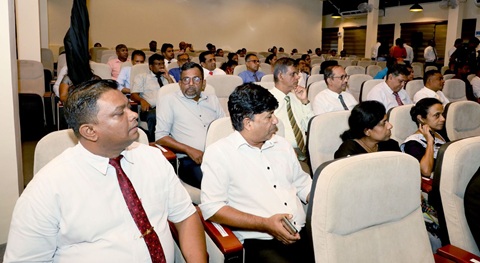
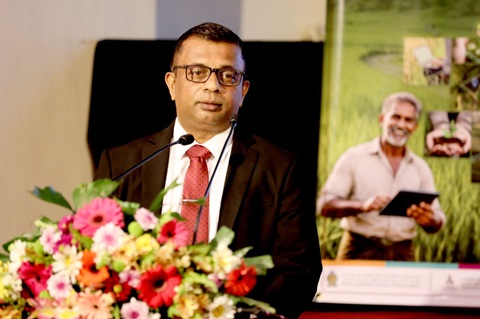
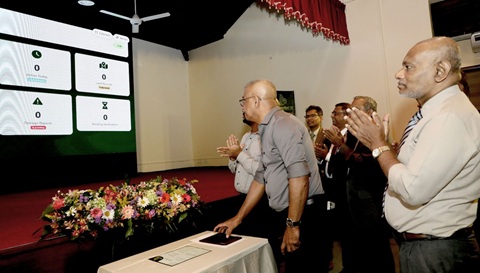
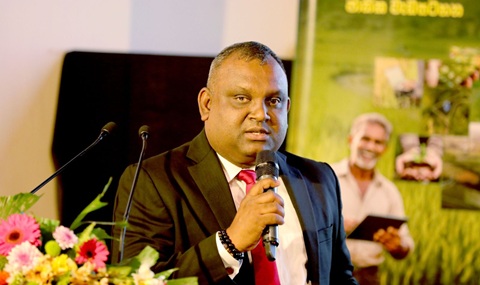
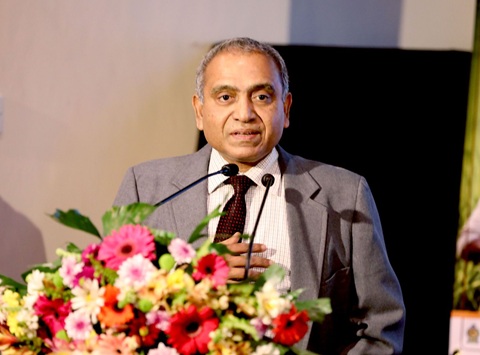
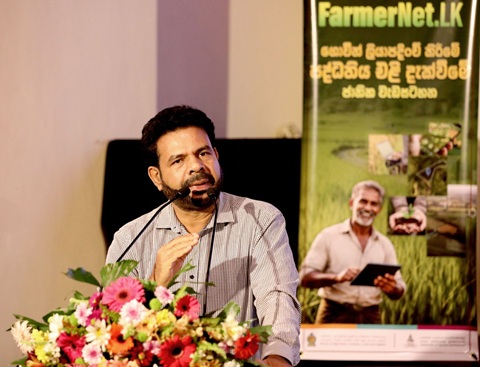
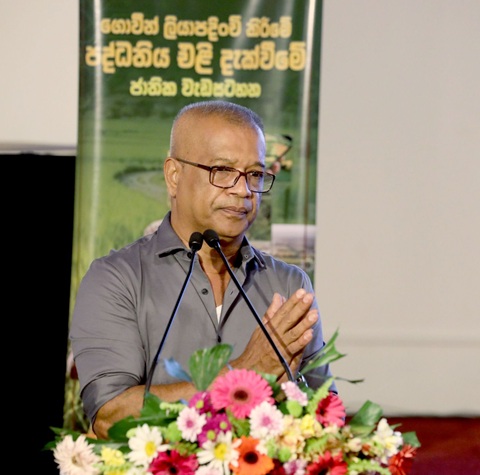
The National Program for the Launch of the Farmer Registration System was held under the patronage of K.D. Lalkantha, Minister of Agriculture, Livestock, Land and Irrigation.
The National Program for the Launch of the Farmer Registration System, named FarmerNet.lk, was held today (16th) at the Govijana Mandiraya under the patronage of K.D. Lalkantha, Minister of Agriculture, Livestock, Land and Irrigation. With the launch of this farmer registration system, which has been a major shortcoming until now, in seeking solutions to the main problems of data scarcity, difficulty in decision-making, and wastage of resources, the farming community will be able to carry out their tasks more easily than before. Similarly, it provides an opportunity for agricultural officers to easily provide necessary services to the farming community.
Digitalization of public service is a main state policy of the current government. This national program comes into operation from today as one step of that. On many occasions, the lack of a systematic data system has been a major obstacle in providing various benefits for farmers. Through this FarmerNet.lk system, being able to obtain details of all farmers scattered across the island from a single location is a great convenience.
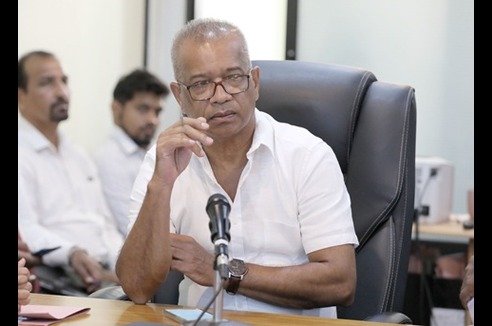
Joining this occasion, K.D. Lalkantha, Minister of Agriculture, Livestock, Land and Irrigation, expressed his views.
It wasn’t easy for us to start this work. Similarly, maintaining the work is also not something that will be easy. We have now increased the price of Keeri Samba. The price that was at 132 has now been increased to 140 rupees. The reason for doing so is that we want to increase the land area where Keeri Samba is cultivated as well as increase the harvest. If we increase the price in this season, we can increase the cultivation area in the next season.
We are now in a transitional era. What we transformed first was politics. We are making a transformation in education. In our country, there is a backward mentality. There are backward cultural characteristics. Similarly, there are progressive attitudes. Today, this work is progressive, positive work. Throughout the world, when something new comes, there is one group that opposes it. There is a section that relies on conventional things. They don’t like modernization.
Our new farmers will undoubtedly connect with this rapidly. For other farmers as well, our agricultural officers will provide the necessary support for that. We are now self-sufficient in rice. We are self-sufficient in green gram. Now we don’t import canned fish from abroad. Many people don’t know that. We have a significant problem with this technology.
If we don’t move forward by defeating backward forces, we cannot take the country to the place we hope for. When many great philosophers brought forward their ideas, generally the majority of society has opposed them.
On this occasion, Namal Karunaratne, Deputy Minister of Agriculture and Livestock, also expressed his views.
A scientific approach is needed regarding matters such as to what extent we have cultivated each crop, what is the number of farmers who cultivated, how much water is required. Only if we have that can we manage these things. Our land is limited. Land must be managed. Greater productivity must be obtained from less land. In a few more years, our agriculture must be elevated technologically and scientifically. The farmer in our country must rise from where they are. Similarly, the consumer must also be protected.
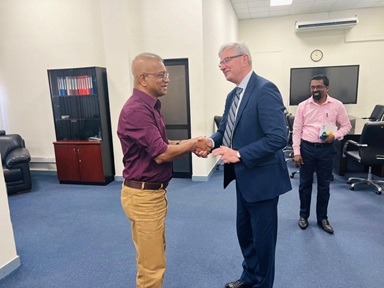
This occasion was attended by D.P. Wickremasinghe, Secretary of the Ministry of Agriculture, Livestock, Land and Irrigation, Dhammika Ranathunga, Commissioner General of Agrarian Development of the Department of Agrarian Development, other officers of the Department of Agrarian Development, as well as representatives of farmer organizations.