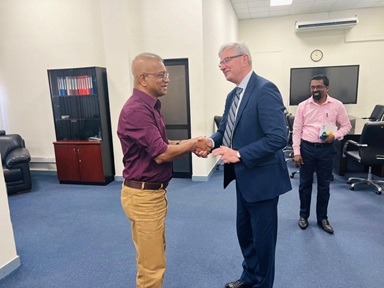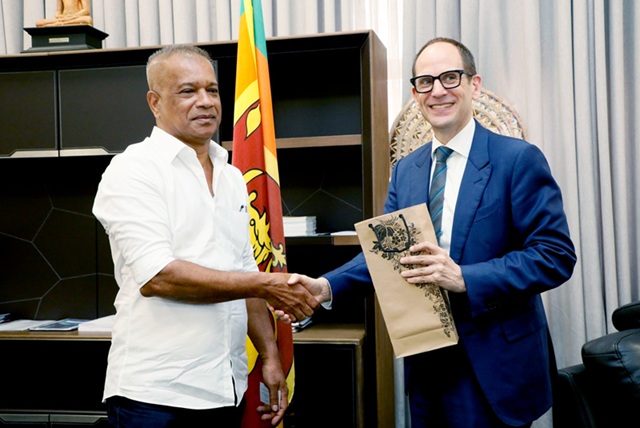
A meeting between the Canadian High Commissioner to Sri Lanka, Eric Walsh and Mr. K.D. Lalkantha
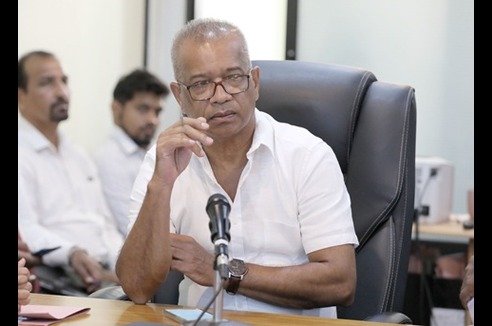
A meeting between the Canadian High Commissioner to Sri Lanka, Eric Walsh and the Minister of Agriculture, Livestock, Land and Irrigation, K.D. Lalkantha was held at the Ministry.
Officials from the High Commission of Canada and a group of officials including the Secretary to the Ministry, D.P. Wickramasinghe also participated in the meeting.
This meeting was held with the aim of further strengthening the relations between Sri Lanka and Canada and providing the necessary support for the development of agricultural sector of Sri Lanka. The High Commissioner stated that the Canadian government will continue to support Sri Lanka’s development and that they are prepared to prioritize development projects in line with the objectives of the new government.
He also stated that, through the Climate-Smart Agriculture Project implemented last year, farmers in selected regions of Sri Lanka were provided with the necessary knowledge on how to carry out and manage agriculture in the face of climate change. Additionally, training and awareness programs were conducted on adding value to agricultural crops and expanding market opportunities. The High Commissioner expressed hope that similar projects would be introduced in Sri Lanka in the future.
Expressing his views, the Minister stated that agricultural lands in Sri Lanka are currently very small in scale, making it difficult to adopt new technologies, improve productivity, and reduce costs. He further commented that previous governments had taken away farmers’ land ownership and allocated it to private institutions, facilitating the establishment of large enterprises. However, the objective of the new government is to allow farmers to retain ownership of their lands while encouraging them to form large-scale agricultural enterprises. This approach aims to enable them to compete with private institutions and supply the market with the necessary agricultural products. The Minister stated that the government’s goal is to transform farmers, who have long remained economically disadvantaged, into agricultural entrepreneurs, thereby advancing both economically and socially. He also requested the Canadian High Commissioner to implement support programs from Canada in the future to help achieve this objective.
The Minister also stated that due to the 30 year war in Sri Lanka, the irrigation systems in the Northern and Eastern provinces were destroyed, leading to the devastation of agricultural lands. He emphasized that the current government prioritizes the restoration and development of these systems and requested the Canadian government to consider the possible support it could provide for this initiative. Furthermore, he noted that the government is not only focusing on the agricultural sector but is also paying close attention to the development of the livestock sector in the Northern and Eastern provinces.
In response, the Canadian High Commissioner stated that Canada has achieved significant development in its agricultural sector through farmer cooperatives, which were formed by bringing together small scale farmers. He explained that these cooperatives have gone beyond traditional farming by adding value to agricultural products and expanding into export processes.
The High Commissioner also stated that Canada is looking forward to investing in the Northern and Eastern provinces of Sri Lanka. He further explained that although Ginseng is not a traditional crop in Canada, it has become one of the country’s primary export crops, capturing a significant share of the global market by exporting Ginseng and related products to many countries. Highlighting similar opportunities for Sri Lanka, he pointed out that products such as Ceylon cinnamon and Moringa powder or tablets could be marketed internationally. Additionally, he stated that Canada recognizes the potential for developing Sri Lanka’s agricultural sector with a focus on international markets.
The Minister expressed his special gratitude for the High Commissioner’s progressive ideas and commitment to enhancing cooperation. He also emphasized the need for a program to facilitate the exchange of agricultural knowledge and technology between the two countries. The meeting concluded with the expectation of another discussion in the near future.