A massive step by the Nikaweratiya Farm owned by the National Livestock Development Board to uplift the local dairy cattle industry
Under the “A Thriving Nation – A Beautiful Life” policy statement, the Ministry of Agriculture, Livestock, Land and Irrigation has implemented a new National Livestock Policy to ensure the country’s food security and to strengthen the livestock sector. A sum of Rs. 1,000 million was allocated in the 2026 national budget to carry out the upcoming programs of the National Livestock Development Board, targeting rural farming communities.
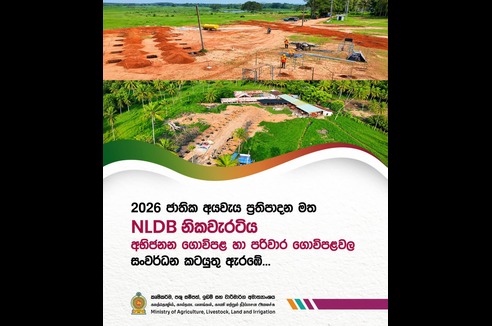
Under the 2026 budget allocations, the National Livestock Development Board has now begun developing the Nikaweratiya Farm into a fully equipped breeder farm. Under the first phase of this national project, 300 acres of land at the Nikaweratiya Farm will be developed as a breeder farm. In addition, fully equipped cattle sheds are being built at five multiplier farms belonging to the Board. Cultivation areas with modern irrigation systems are also being established so that the maize needed for animal feed can be grown in 3 seasons throughout the year. This is the first time in the history of the National Livestock Development Board that the largest extent of land (500 acres) will be irrigated at once. Under this system, water will be supplied to the entire 500 acres of maize cultivation i.e., 280 acres under the Pivot Irrigation method, 100 acres under the Solar Sprinkler method and 120 acres under the Hose Reel method.
As the first step in developing the Nikaweratiya Farm with full infrastructure, the Board plans to import 400 Sahiwal cows and under the initial phase, 200 of these cattle are scheduled to be brought to the country. The Sahiwal is one of the world’s finest indigenous dairy breeds, originating from tropical Pakistan and the Punjab region of India. It is considered as a very popular and strong breed for dairy farming in countries with a tropical and hot climate, such as Sri Lanka. It is planned to artificially inseminate these animals with high-grade European breeds such as Friesian and Jersey in order to produce a new generation of crossbreeds. Subsequently, these cows will be handed over to the five proposed multiplier farms and the Board’s primary aim is to provide new cows that are well suited to the local environment and have high breeding potential to farmers through those multiplier farms.
This is one of the most carefully planned, large-scale breeding projects in Sri Lanka’s livestock sector. Under this project, the Board also aims to raise the number of artificial inseminations carried out using sex-sorted bovine semen to 100,000 by 2030.