The National Food Promotion Board introduces banana leaf packaging as a biodegradable packaging instead of polythene bags.
Food security takes priority within agricultural policy. Food safety is also included within food security. A practical solution for food safety has still not been found. In Sri Lanka’s food industry, polythene is used for food packaging (Lunch Sheets). Packing food in polythene bags is not a health-safe method. This is harmful to health as it allows chemical components to enter the body. The addition of polythene bags to the environment also creates major environmental problems. The large quantities of polythene bags discarded into the environment daily directly contribute to environmental pollution. When considering these factors, it is timely to introduce an alternative solution instead of polythene bags, that is, another substitute.
Encouraging and promoting agriculture-based businesses is also a matter included in agricultural policy. In this regard, special support should be given to environmentally friendly businesses. Accordingly, the National Food Promotion Board has introduced biodegradable packaging instead of polythene packaging. Banana leaf packaging can be used as a biodegradable packaging.
Banana leaf packaging production can be carried out as an industry. Banana leaves are used when packing food at home, and it can also be carried out as an industry on a commercial scale.
Initially, the preparation of banana leaf packaging was done in a very primitive manner. Primitive methods such as dipping banana leaves in hot water or softening banana leaves with steam were followed. However, through these methods, banana leaf packaging production cannot be done on a commercial scale. As a remedy for this, it has been possible to manufacture a machine for this purpose. This machine operates on electricity. The production of the machine costs approximately four hundred thousand rupees. Due to the difficulty of spending such a large amount of money, attention of the National Food Promotion Board was drawn towards seeking an alternative solution for this problem.
Accordingly, research work has been initiated with students referred to the National Food Promotion Board for research by the university to produce a simple machine for softening banana leaves. As a result of that research, a student from the Faculty of Agricultural Technology and Rural Sciences at the University of Colombo has produced a simple machine for softening banana leaves. This machine operates on charcoal, which is a renewable energy source. Through the machine, it is possible to soften between 250 to 300 banana leaves within an hour. This machine can be introduced as a more efficient and cost-effective machine for those running it as a cottage industry.
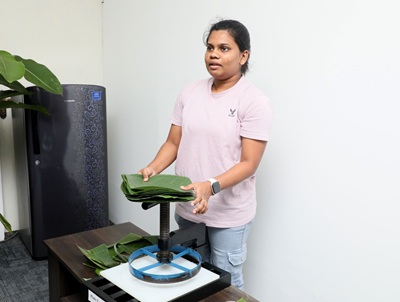
A final year student studying at the Faculty of Agricultural Technology and Rural Sciences at the University of Colombo has succeeded in producing a simple hand-operated machine for cutting banana leaves as well. Through this, it is possible to cut about ten banana leaves at once in a circular shape.
A problem that arises when using banana leaves as a biodegradable packaging is the inability to cultivate bananas in certain areas of Sri Lanka. The National Food Promotion Board has identified that the Heliconia Bihai plant can be used as an alternative to this. A student from the Faculty of Agricultural Technology and Rural Sciences at the University of Colombo is also involved in this research work. Heliconia Bihai is an ornamental plant that belongs to the banana family itself. A special feature is that it can be cultivated under any environmental conditions.
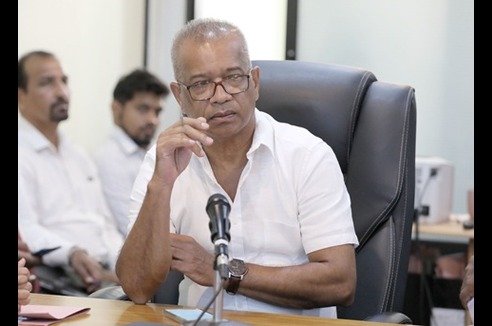
At a time when the addition of polythene to the environment has become a serious environmental problem, seeking alternative solutions for it is timely. Especially, to reduce the amount of polythene packaging released into the environment daily to some extent, the use of banana leaves as a biodegradable packaging should be encouraged. For this purpose, the efforts made by Dr. Sujatha Weerasinghe, Chairperson of the National Food Promotion Board, should be appreciated.