SARP Initiative to Promote Forest Enrichment and Conservation of Tank Catchment Areas
Protecting catchment areas and restoring ecosystems is extremely important for the long-term sustainability of tank systems. Planting trees in degraded catchment areas and maintaining them is expected to conserve soil, protect water resources and strengthen the climate resilience of farming communities.
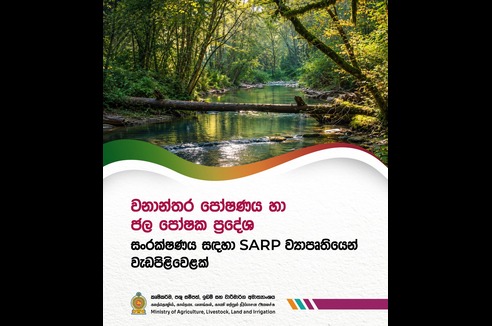
The Smallholder Agribusiness and Resilience Project (SARP) implemented under the Ministry of Agriculture, Livestock, Land and Irrigation, has launched this programme to restore the catchment areas of selected tanks under a Memorandum of Understanding signed with the Department of Forest Conservation (DFC).
Under the first phase of the programme, it was proposed to restore 562.91 hectares of degraded land belonging to 46 identified tank catchment areas in the Anuradhapura, Kurunegala and Puttalam districts.
In November 2025, seedlings were planted at selected sites in the Anuradhapura district. According to Department of Forest Conservation records, planting has been carried out on 413.9 hectares of land in that district using 112,200 seedlings. The SARP project, the Department of Forest Conservation and community representatives have also jointly carried out field inspections of the condition and survival of the planted seedlings.
Maintenance of the seedlings planted in the Anuradhapura district is currently under way, while the seedlings due to be planted in the Kurunegala and Puttalam districts are being nurtured in nurseries of the Department of Forest Conservation. According to the plan, planting in those districts is scheduled to begin in the coming November.
Under this programme, a variety of plant species have been selected for cultivation, including mangrove, mee, kumbuk, karanda, madan, kaluwara and tamarind. By using species suited to soil, water and environmental conditions of the area, the programme aims to strengthen the ecological condition of the catchment areas and restore degraded lands.
Future actions include continuing tree planting and maintenance activities in collaboration with the Department of Forest Conservation, and monitoring seedling survival. Future plans also include alternatives such as boundary planting, integrated home gardening and alley cropping in suitable areas.
Collaboration between SARP and the Department of Forest Conservation is important for conserving catchment areas, protecting soil and water and building agricultural systems that can withstand climate change. The aim of this programme is to deliver sustainable benefits to the surrounding ecosystems and the farming communities that depend on them, not merely by planting trees, but by maintaining them properly and protecting them over the long term.
Farmers and other interested parties who would like more information about this programme can contact the Smallholder Agribusiness and Resilience Project (SARP) on 011 277 0986.