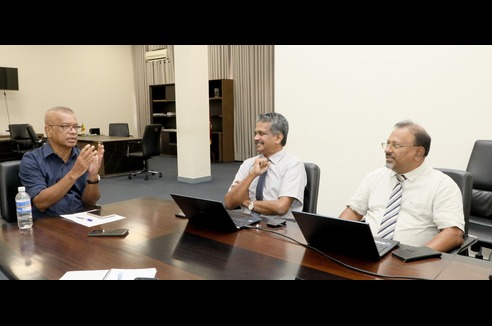
A special discussion on the proposal to use the Environmental Impact Quotient (EIQ) for pesticide selection was held at the Ministry of Agriculture under the patronage of Minister of Agriculture, Livestock, Land and Irrigation, Mr. K.D. Lalkantha.
A special discussion on the proposal to use the Environmental Impact Quotient (EIQ) for pesticide selection was held today (30th) at the Ministry of Agriculture, under the patronage of Minister of Agriculture, Livestock, Land and Irrigation, Mr. K.D. Lalkantha. Senior Professor Buddhi Marambe of the Faculty of Agriculture, University of Peradeniya, specializing in Crop Science, participated in this discussion.
At this occasion, the Professor explained the matters relating to the proposal to use the Environmental Impact Quotient (EIQ) for pesticide selection.
“The use of pesticides has already become an essential component for increasing the productivity of our agriculture. When using such chemicals, we are well aware that what is fundamentally important to us is how effectively a pesticide kills a pest through that chemical or product, as well as how economically advantageously farmers are able to obtain that pesticide. In addition to these two factors, we are currently paying close attention to the harm caused by those pesticides to mammals. However, we have not had a quantitative analytical assessment of how a pesticide currently in use may affect the ecosystem in the future, inclusive of all components within the ecosystem, including humans. But many years ago, in 1992, Cornell University in the United States introduced a coefficient known as the Environmental Impact Quotient, which we refer to in English as EIQ. Although considerable attention was paid to this coefficient when it was first introduced, due to insufficient data at the time, the researchers continued to improve it by updating the data based on the results of research conducted on this Environmental Impact Quotient. By the year 2007, even the United Nations Food and Agriculture Organization had presented recommendations on how the Environmental Impact Quotient, or EIQ value, could be applied in integrated pest management. In the current situation we are in today, we have reached a point where we can apply the Environmental Impact Quotient even more successfully than before. As I mentioned earlier, by using a combined coefficient covering the ability to kill pests, its economic importance, and in addition, its impact on the overall environment, we are now able to arrive at a data-based, accurate conclusion regarding how all pesticides currently used in our country should be recommended or selected. Through this Environmental Impact Quotient, we are not setting aside the methods we have used up until now. We do not intend, nor do we propose in any way, to make changes to the calculations based on the impact on mammals, particularly those based on LD50 values or to the colour coding on pesticide labels. However, in addition to that, what this Environmental Impact Quotient provides is the ability for scientists, as well as farmers through awareness, to more successfully select a pesticide that is most important to them, most beneficial to them, and not harmful to future environmental conditions. This is the specific mission carried out by this Environmental Impact Quotient. Today we met Hon. Minister of Agriculture, Mr. Lalkantha, to raise awareness on this matter. The Director of the Postgraduate Institute of Agriculture of the University of Peradeniya, Mr. Ajith Gunasekara of the GRIMO institution and I met the Minister and we entered into a round of discussions with the Minister presenting our proposals regarding this Environmental Impact Quotient and how they can be implemented. From here onwards, we hope that in the near future, following a good round of discussions together with the heads of pesticide-recommending institutions within other state institutions including the Department of Agriculture, as well as the scientists associated with them, this Environmental Impact Quotient will be used in an even more successful manner as an important component in both pesticide recommendation and effective pesticide selection.”