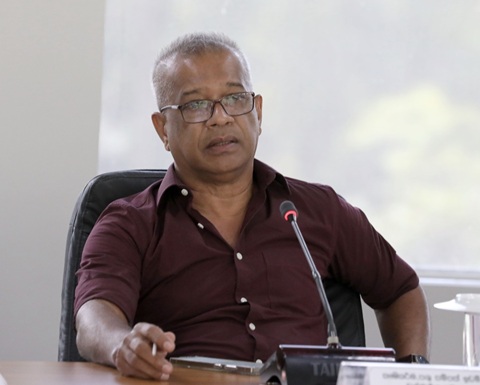
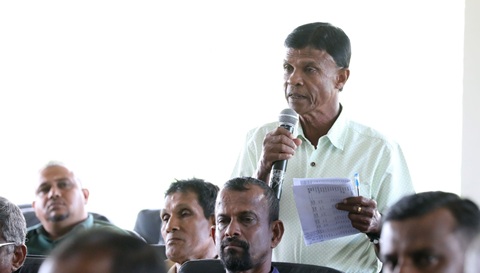
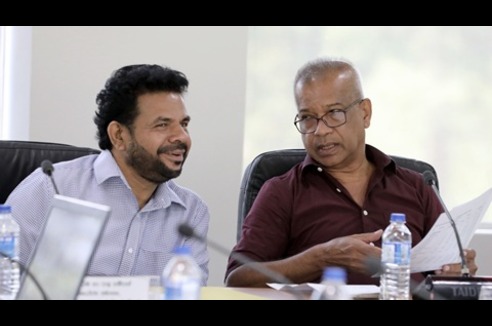
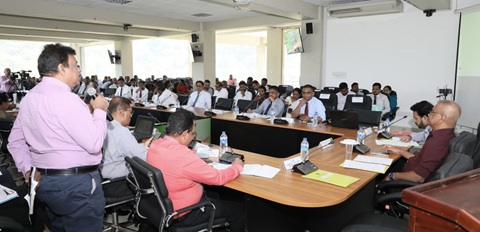
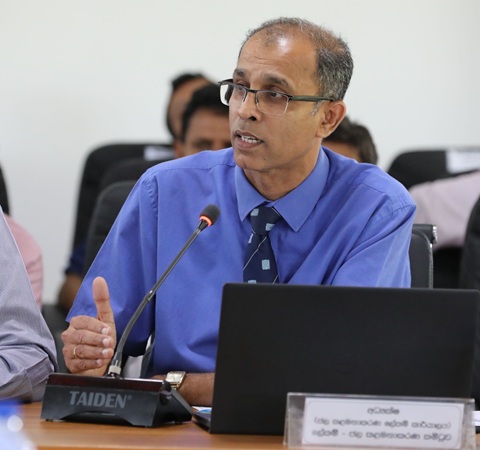
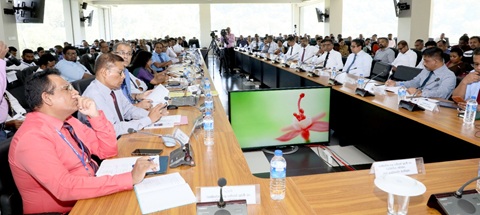
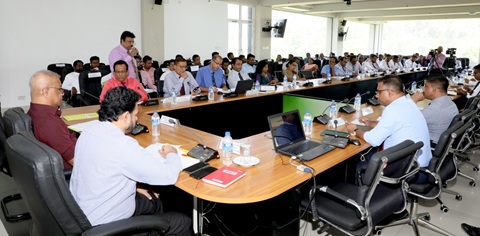
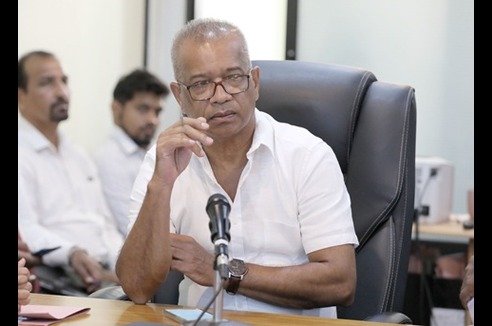
The Mahaweli Water Management Committee meets under the patronage of Minister of Agriculture, Livestock, Land and Irrigation, K.D. Lalkantha.
The Mahaweli Water Management Committee met today (13th) at the Gannoruwa Information and Communication Centre under the patronage of Minister of Agriculture, Livestock, Land and Irrigation, K.D. Lalkantha.
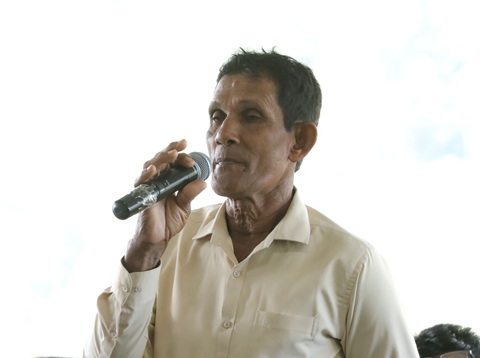
Water distribution for the Yala season was discussed at the meeting. Officials of the Mahaweli Authority, officials of the Department of Irrigation, farmer organizations and the political authority, jointly made a series of special decisions regarding the manner in which water should be distributed to paddy fields during the Yala season.
Participating in this event, the Minister expressed the following views:
“Maize cultivation is just as important as paddy cultivation. We only cultivate 50% of our maize needs domestically and the rest is imported. We cannot progress further with maize. It is difficult to significantly increase the acreage under maize cultivation, because there is a land shortage in the country. It is also difficult to increase maize yields. Therefore, we are thinking to increase the yield from the land currently under paddy cultivation. In addition to the amount of rice needed for our own consumption, we are looking at using rice for other products as well. It would be good if more by-products are made from rice. For that reason, our attention is now focused on removing the restrictions placed on rice for the production of certain goods. To achieve this, paddy production must be increased. However, there is no expectation of increasing paddy lands. In that context, we ask farmers to properly implement the package provided by the Department of Agriculture. That is still not happening across the country.”
One of our goals is to bring farmers to a position where, instead of bringing their entire paddy harvest to the market at once, they are able to hold it for a week or two. We need to develop a system for paddy drying and storage. A farmer’s role currently ends once the harvest is cut and handed over. Two more steps need to be added to that. Paddy drying and storage are the two steps that need to be incorporated at that point. We are moving towards a program for that purpose.
We have two main concerns. One is to uplift the lives of farmers. The other is food security. If a fair profit is not given to the farmer, farming cannot be sustained. We have not gazetted a paddy price or made it a law. Our intention is to prevent the private sector from buying paddy at low prices. We accept the point that the intervention of the Paddy Marketing Board is insufficient. There are storage issues and staffing issues.
We were afraid that it would take some time to revive agriculture after the cyclone Ditwah. However, we paid compensation and farmers started cultivating again. We must be grateful to the farmers for that. Likewise, we must also be grateful to the government officials who work together with farmers.
We have to import Keeri Samba rice from abroad. Therefore, we are requesting farmers to cultivate more Keeri Samba.