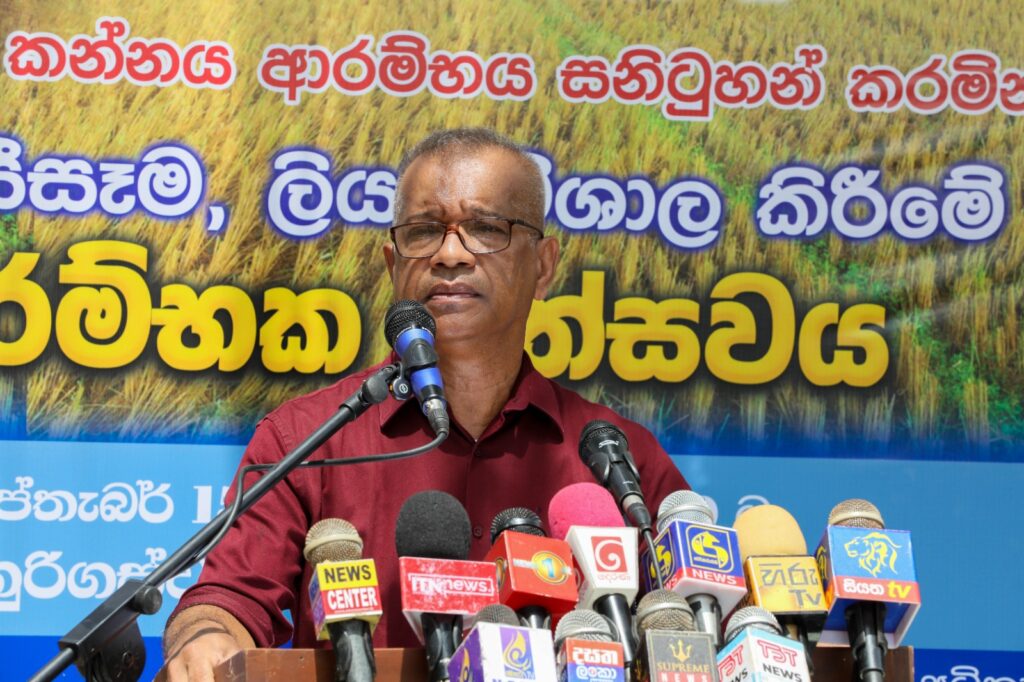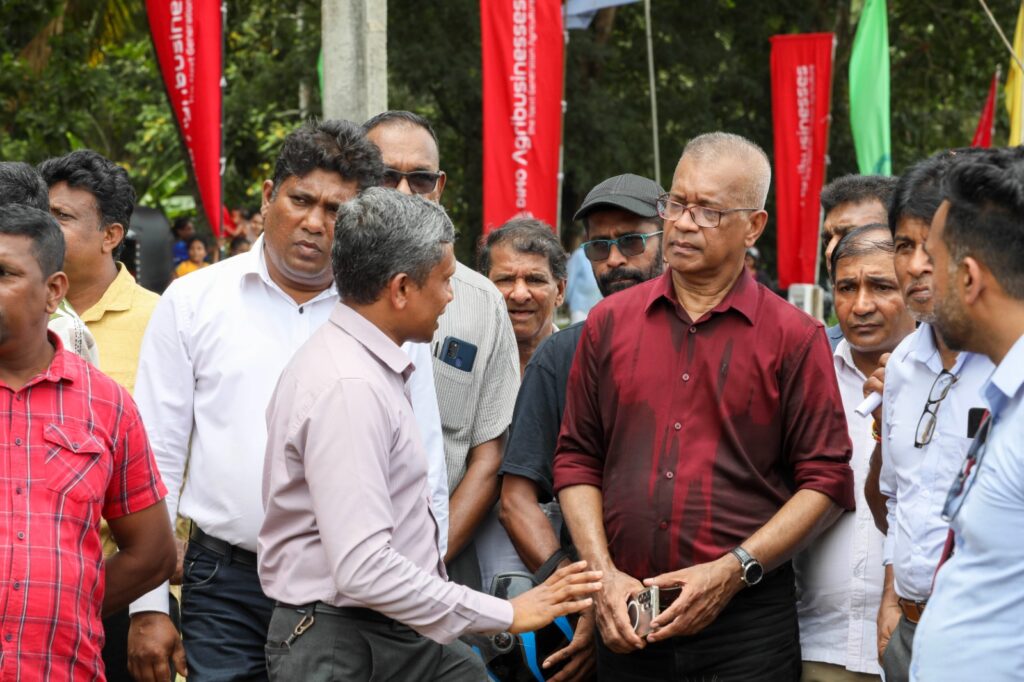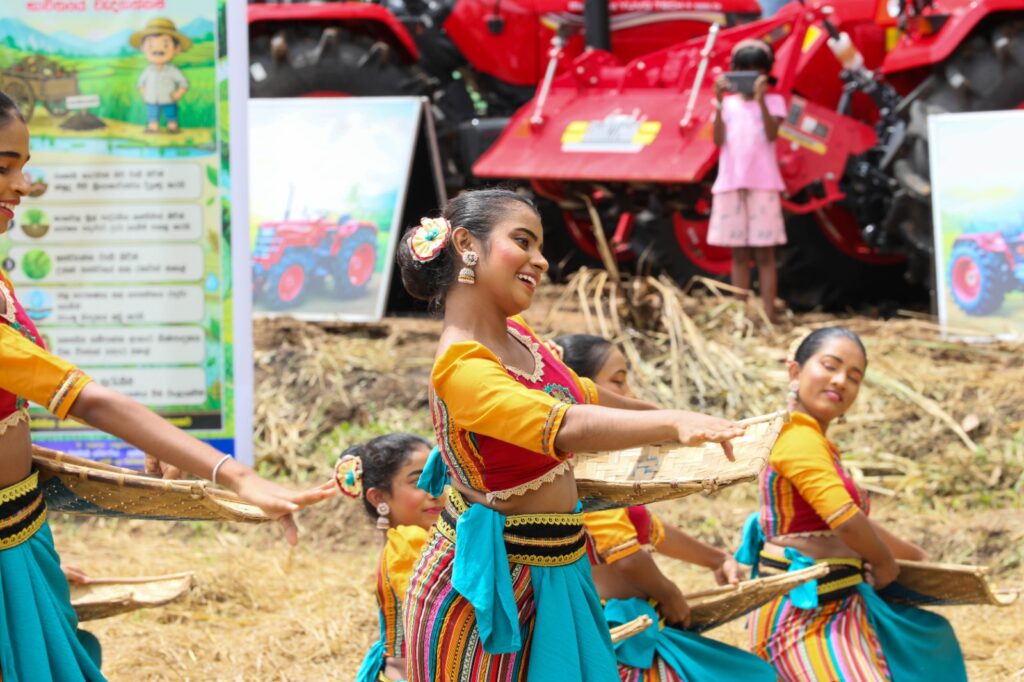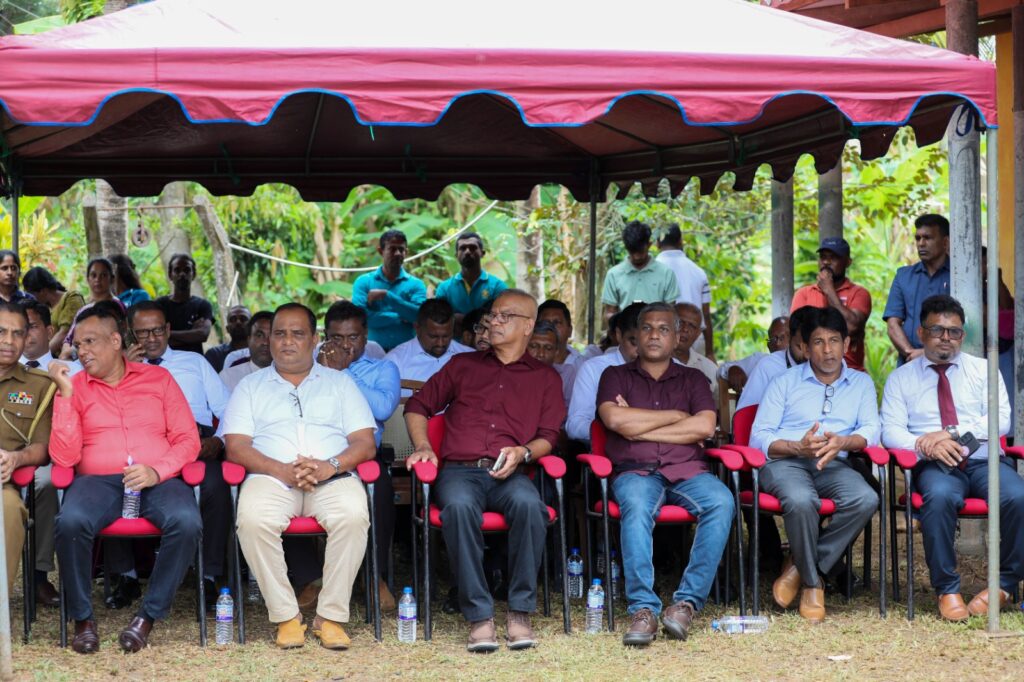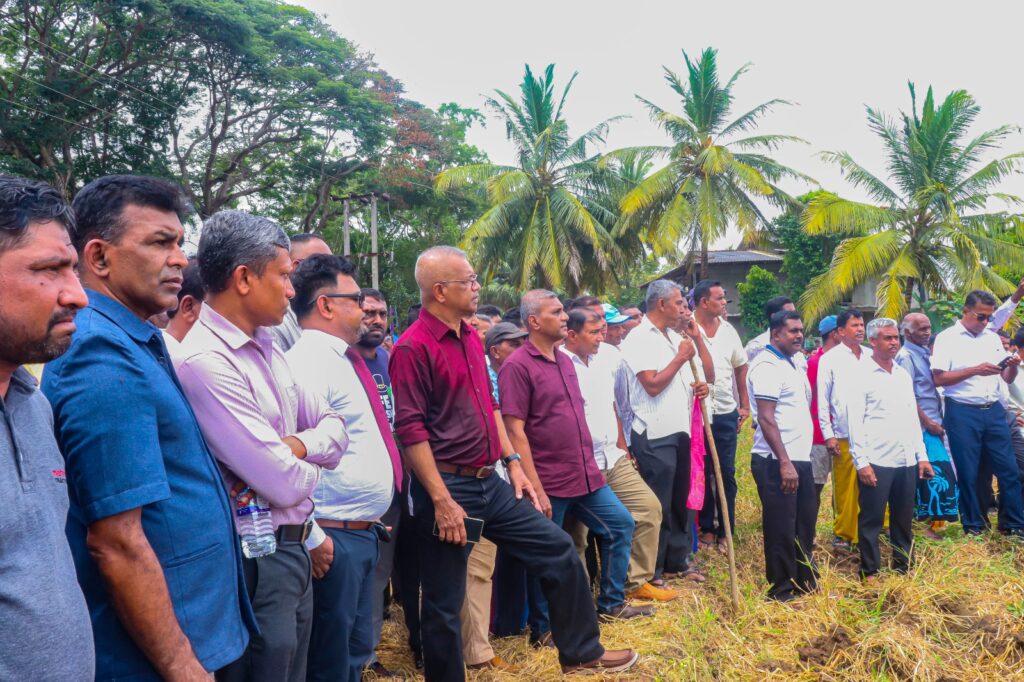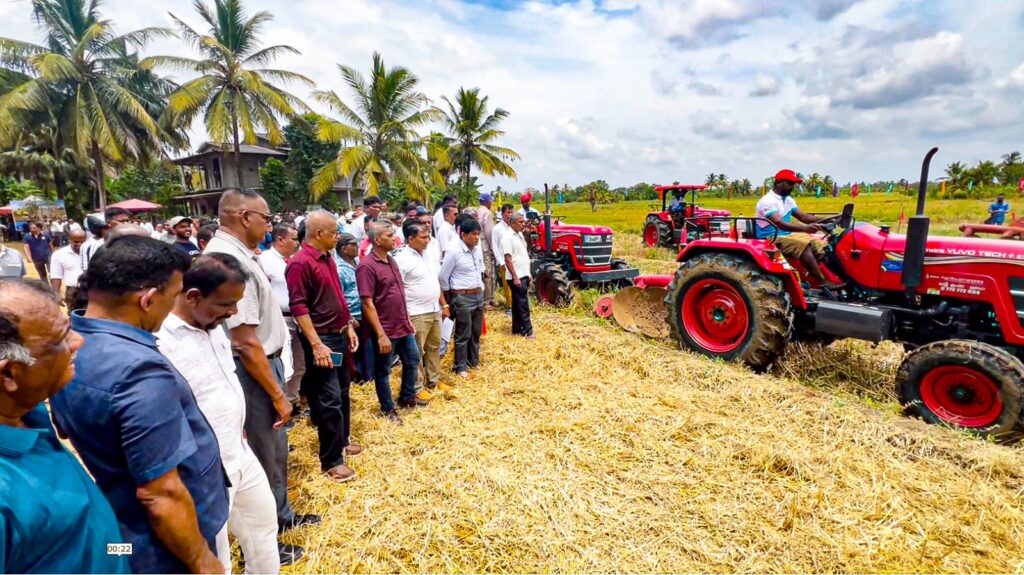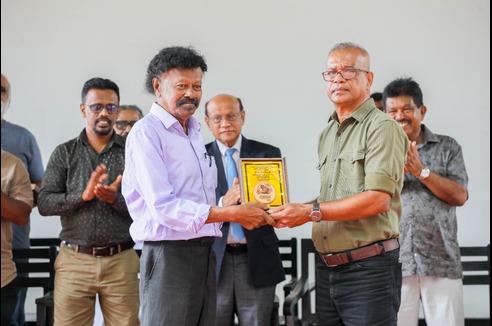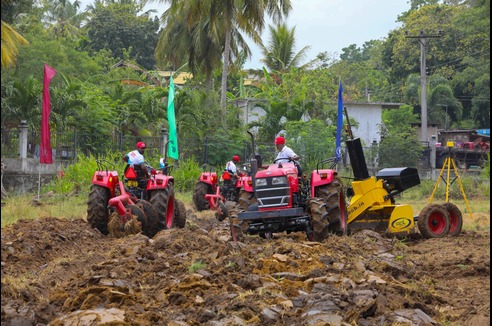
Minister of Agriculture, Livestock, Land and Irrigation, Mr. K.D. Lal Kantha, participates in the Vap Magula ceremony (ploughing festival) in the Mahaweli H zone.
The “Adarsha Yaya” National Program, operated under the “Punarudayata Arunalu” National Agriculture Program, is implemented covering 10 Mahaweli zones. It targets 5,000 hectares within a single cultivation season and aims for 150 paddy tracts. Minister of Agriculture, Livestock, Land and Irrigation, Mr. K.D. Lal Kantha, attended this event on the 15th.
This program is implemented as a three-year initiative, aiming to cover 30,000 hectares and complete 900 paddy tracts by the end of the 03 years.
Under this program, 10 main activities are implemented within the “Adarsha Yaya” and the Mahaweli Authority provides encouragement and support to farmers. Key measures include conducting training programs, providing seed subsidies, enlarging paddy plots (liyadhi), deep ploughing and providing a subsidy to encourage the use of organic fertilizer. Additionally, farmers are provided with necessary training for proper weed control, pest management and water management.
The objective of today’s program is to move away from using rotavators for primary land preparation toward deep soil tillage, and to raise awareness among farmers to begin land preparation prior to the release of water.
This program was launched in the previous Maha season, namely the 2026/27 Maha season, and harvest surveys conducted during that season confirmed that 65% of farmers obtained a yield exceeding 6 metric tons per hectare. The proportion exceeding 7 metric tons stood at 35%. Furthermore, under the “ Adarsha Yaya” National Program implemented during the 2026 Yala season, 79% of farmers achieved a yield exceeding 6 metric tons per hectare, while the proportions exceeding 7 and 8 metric tons were 40% and 17%, respectively.
Under this program, a yield of 12.5 metric tons per hectare (245 bushels per acre) was reported from the Mahaweli Walawa zone, while the highest Keeri Samba yield recorded to date i.e.11.4 metric tons per hectare (222 bushels per acre) was obtained from the Mahaweli C zone.
The Minister, who participated in this event, expressed his views as follows:
“The International Rice Research Institute is located in the Philippines. Back in the 70s, they said that we should get at least 80 bushels of paddy per acre. Look at how much time has passed since then. If proper water management is provided, if improved seeds are used, if the plants are given the necessary nutrients in the right amount at the right time and if pesticides and weedicides are applied correctly, getting 80 bushels of paddy per acre isn’t a major challenge. During that period, our country produced only about 30 bushels of paddy per acre. At that time, we used traditional, unimproved seeds. Even today, in some areas, they only harvest 60 bushels per acre. If someone is still getting only 60 or 70 bushels today, he is not a real farmer. There’s no point in farming like that. During this time, we must get at least a minimum of 120 bushels of paddy per acre. Otherwise, the money allocated for irrigation and fertilizer subsidies becomes meaningless.
In this Walawa zone, the yield exceeds 200 bushels of paddy per acre. After I mentioned that, a farmers’ organization challenged me, offering to give me one acre from every district and asking me to prove it by doing it myself. That is a good challenge. We have no intention of increasing the total acreage under paddy cultivation. Instead, we must cultivate other cash crops. Most of these additional crops are still being imported from abroad. Outside of the Mahaweli zones and major irrigation schemes, we hope to promote additional crop cultivation in areas with tanks under 200 acres managed by the Department of Agrarian Development.
We designated 500 special paddy tracts (“Yayas”). Nationally, we add 500 new paddy tracts every cultivation season. Our goal is 5,000 paddy tracts. In this case, ploughing is done as soon as the cultivation season ends and tilling the ground to a depth of 9 inches. Although this incurs a slightly higher cost, it causes no issue because the paddy yield increases. At present, there is something known as fourth-generation fertilizer. It is not yet used in our paddy cultivation. We are still using first-generation fertilizer. We will select 15 paddy tracts with the involvement of the private sector and cultivate them using fourth-generation fertilizer while implementing the package recommended by the Department of Agriculture.
We expect to increase the storage facilities of the Paddy Marketing Board and have the government purchase a larger quantity of paddy from farmers. Currently, we only buy 3%. The government should purchase at least 10% from farmers. Otherwise, we cannot stop the private sector from exploiting them. We have a plan for that. Straw is still being burned although we emphasized not to do so. In addition to chemical fertilizers, organic matter must be applied. Then only, we can boost paddy production.”